Super Ace vs Super Ace Deluxe: Symbols and Free Games

By Version Desk editorial project · Revised 2026-11-05 · Published 5 November 2026.

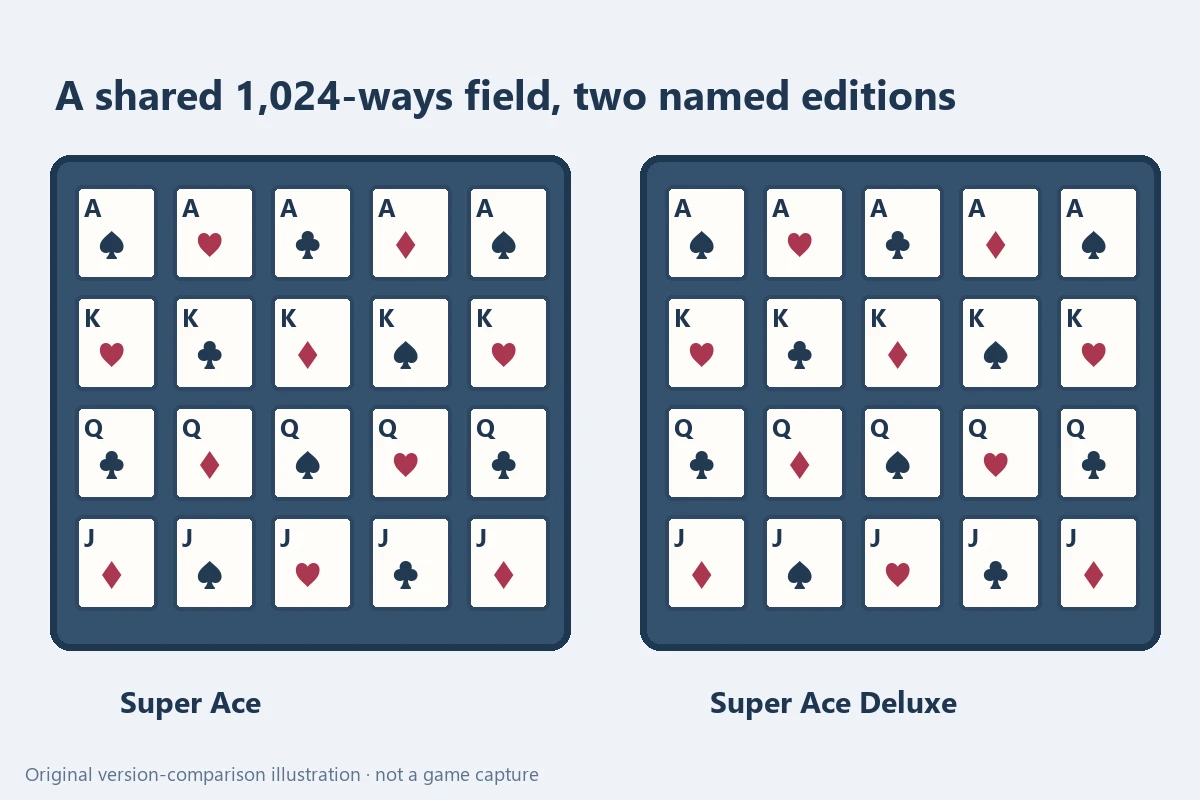
Two original card-grid interfaces are labelled Super Ace and Super Ace Deluxe, with five columns and four rows each.
The schematic pair visualises a shared ways field without claiming a captured build or a complete paytable.

Super Ace and Super Ace Deluxe are separate JILI titles with the same published 1,024-ways count but different descriptions of their features. The original game-info page names elimination-based multiplier accumulation and a Golden Card-to-Golden Joker change; the Deluxe page specifies a four-by-five card layout, accumulation up to twenty times and ten free games from three Scatters. The differences below are limited to those two official game-info snapshots. 12

Published fields side by side

Each column is limited to its named official game-info snapshot, accessed 5 November 2026.
FieldSuper AceSuper Ace Deluxe
Ways field1,024 ways1,024 ways
Named card transformationGolden Card eliminated, then Golden JokerNot established by this short summary
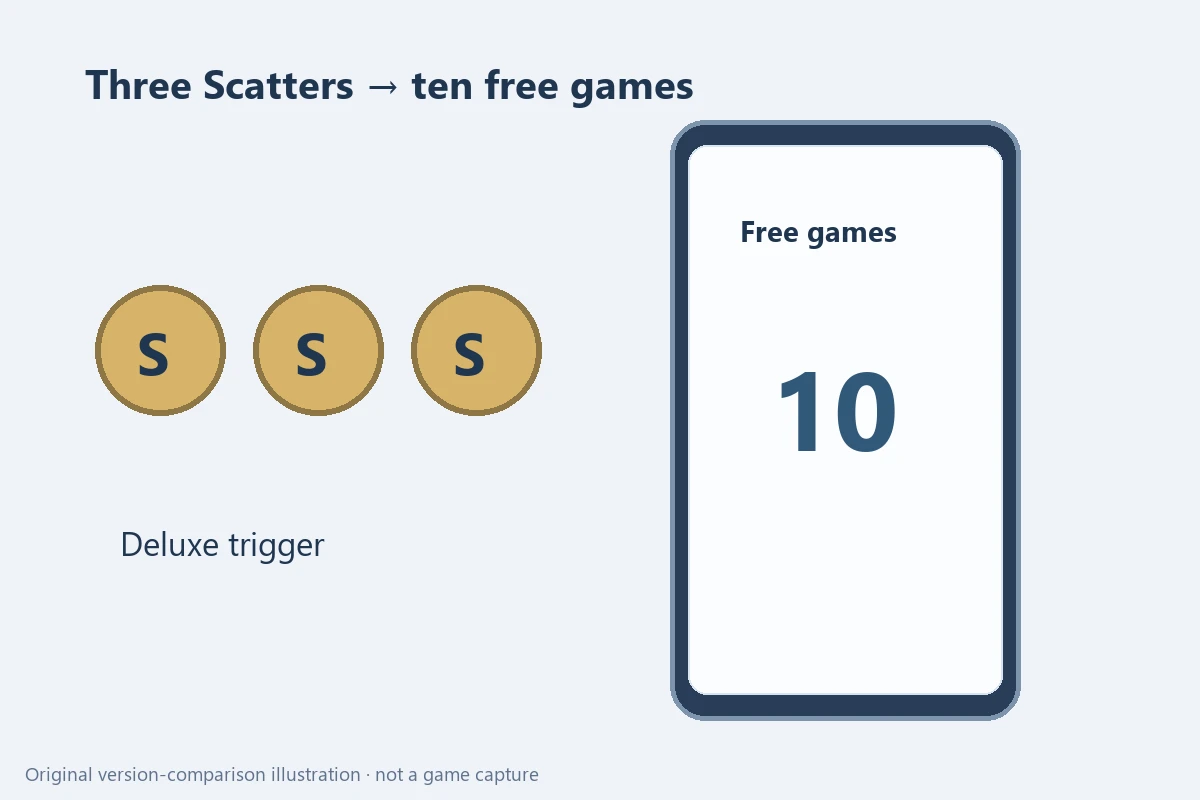
Free-game trigger and countFeature named; this threshold not specified3 Scatters award 10 free games
Elimination accumulationAccumulation described; no ceiling stated hereUp to 20 times in this field
Supplier volatility labelLOW-MEDMED
Published maximum-win field10,000 times10,000 times
Product publication field2020.082024.07

Source columns: original 1 and Deluxe 2. A missing short-summary statement is not proof that a feature is absent.

Shared ways count does not make the releases identical

Both pages publish 1,024 ways, so that number is a shared field rather than a distinguishing advantage. A ways count describes a combination system; it does not state the value of every winning combination, the probability of a feature or a player's expected outcome. Two titles can therefore share a count while presenting different feature descriptions. 12

The phrase four by five appears explicitly in the Deluxe description. Interpreted as five columns with four positions each, four multiplied by itself five times equals 1,024. That arithmetic explains how a rectangular arrangement can be associated with the printed count. It is a layout explanation rather than a calculation of winning chance: not every visible position needs to contain the same symbol, and a nominal ways total does not say that all ways win simultaneously.

Our side-by-side card-grid illustration is schematic. It makes the comparable field visible while avoiding copied game artwork or a claimed capture of a deployed build. The exact symbol table, starting-edge conditions and any exclusions require the rules for the displayed edition. The common count should not be used to copy an unexamined rule from one edition into the other.
The original description connects Golden Card and Golden Joker

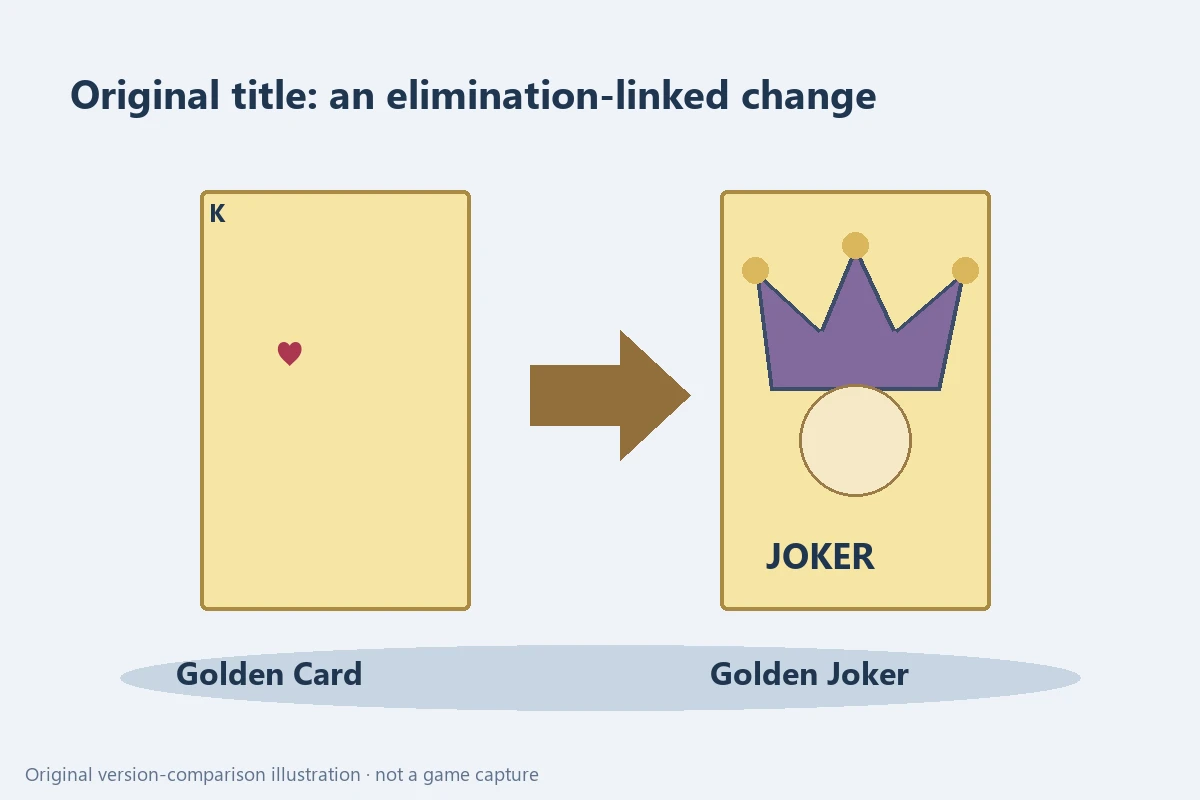
Super Ace's page identifies a specific transformation: a Golden Joker appears after a Golden Card has been eliminated. This is more informative than treating every gold object as one undifferentiated special symbol. A card state before elimination and a Joker state after it occupy different places in the described sequence. 1

A gold-framed King card points toward a gold-framed illustrative Joker card.
The two physical card states show the original title’s named elimination-linked transformation.

For a conceptual example, imagine a gold-framed card among the visible symbols. A description that stops at the gold frame does not yet establish the later Joker. The named transition requires the elimination event in between. Conversely, if a later image shows the Joker, explaining only the original card omits the mechanism that connected the two states. That sequence is what the original card illustration demonstrates.

The same source says consecutive eliminations accumulate multipliers, including a different multiplier treatment in Free Game. These are statements about progression within the named title, not proof that a particular screen will continue indefinitely. The word accumulated indicates that an earlier event can affect a later displayed total; it does not identify the next symbols that will arrive. 1

The retrieved Deluxe text does not repeat the Golden Card-to-Golden Joker sentence. Absence from that short description is not proof that every such object is absent from the game itself. The sound comparison is narrower: the original source explicitly documents this transition, whereas the Deluxe source used here does not establish the same transition. Inventing an exclusion would be as misleading as copying the original mechanic without evidence.

Deluxe makes two feature thresholds explicit

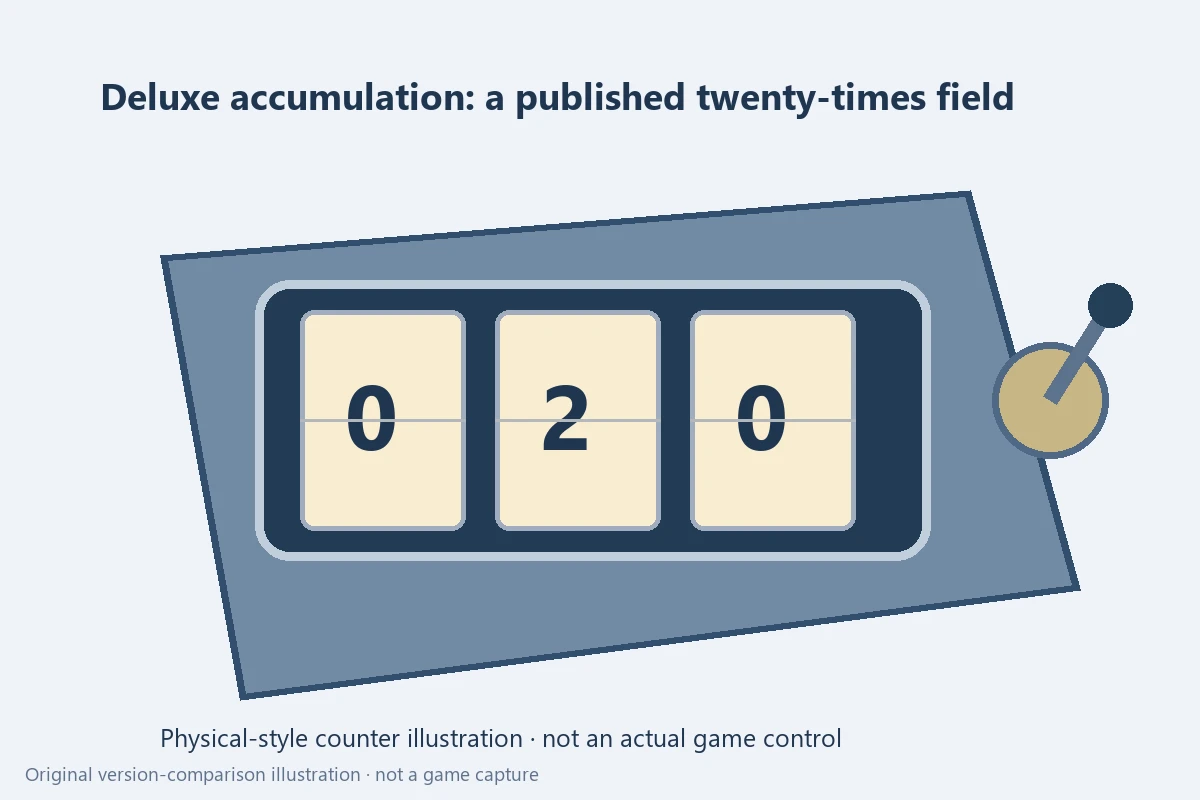
The Deluxe game-info page states that eliminations accumulate multiplier rewards up to twenty times and that three Scatters award ten free games. Those are edition-specific published claims, so the title name belongs beside them. They should not be silently relabelled as statements about the original Super Ace. 2

A large physical-style mechanical counter displays 020 beside a crank.
The counter illustrates the published twenty-times accumulation field as an analogy, not an actual game control or recorded progression.
Three round Scatter emblems sit beside an original phone display showing ten free games.
The edition-specific count relationship is visible while the screen remains an original example, not a live result.

The twenty-times statement and ten-free-games statement measure different things. One describes the accumulation mentioned in the feature text; the other describes the awarded count after a Scatter condition. Combining their numbers into a product would create an unsupported formula. A comparison table should retain the original units and meanings rather than arranging attractive numbers into a new implied maximum.

Three qualifying Scatters and the ten-game award are also separate observations. A picture of two Scatters does not meet the printed trigger; a picture of a counter showing ten is not, by itself, a complete record of how that counter began. The original phone illustration joins the three-symbol condition and the counter in one teaching view, clearly marked as an illustration rather than an actual round.

The original page lists Free Game and Free Spin among its feature fields, but the retrieved text does not supply the same three-Scatter, ten-game threshold. It therefore supports the existence of the named feature category without completing that particular numeric comparison. A missing threshold stays unfilled here instead of being borrowed from Deluxe. 1

Separate volatility labels from maximum-win labels

The original page shows LOW-MED volatility and the Deluxe page shows MED, while both display a maximum-win field of 10,000 times. These are JILI's published labels for the two snapshots, not measurements made by this editorial project. They do not make either title safe, nor do matching maximum labels make their distributions identical. 12

A maximum is a ceiling-like product field, whereas a volatility label is a descriptive category. Neither tells a reader how frequently a particular screen will occur during a short session. In particular, MED is not a percentage and should not be converted into a numeric probability. The comparison preserves the words because the supplier did not publish a statistical conversion in these descriptions.

A practical reading order is edition name, mechanic, condition and finally any numeric field belonging to that condition. That order keeps a headline maximum from swallowing the rest of the comparison. It also helps distinguish an accumulation limit from a game's separate maximum-win field, which describe different levels of the product information.

Use publication fields as identifiers, not a complete chronology

JILI's pages show publication fields of August 2020 for Super Ace and July 2024 for Super Ace Deluxe. These help identify the compared records. They do not establish the date on which every operator or jurisdiction offered the games, and this article does not claim a Philippine launch date from those fields. 12

The resulting comparison is specific: shared ways count, a documented original transformation, explicit Deluxe thresholds and distinct supplier volatility labels. None of those facts provides a recommendation to move from one edition to another. They explain why the full title matters when reading a rule, describing a symbol or checking whether a number has been attached to the correct release.