Three named JILI releases
Fortune Gems Versions: Documented Edition Differences
By Version Desk editorial project · Revised 2026-11-05 · Published 5 November 2026.
Fortune Gems, Fortune Gems 2 and Fortune Gems 3 share a JILI series name and a published five-line field, but their official game-info descriptions identify different feature emphases. The first centres on a multiplier and whole-board presentation, the second names a Lucky Wheel associated with Scatters, and the third specifies a three-by-three board and symbol splitting. This comparison preserves those separate titles rather than treating the series as one interchangeable rulebook. 123
Compare the features that are actually named
The three official records contain overlapping fields, yet their feature lists are not identical. Fortune Gems lists Multiplier. Fortune Gems 2 lists Full Symbol, Multiplier and Lucky Wheel; its description specifically connects Scatters with triggering that wheel. Fortune Gems 3 lists its board size, a multiplier on a point win, symbol split and comprehensive rewards. 123
Those short phrases should be read as evidence boundaries. A named feature can be compared as present in a source without claiming that an unmentioned feature is definitely absent from another executable build. This matters most for the third edition's brief English text, where a compact phrase is not a complete specification of the underlying condition. The comparison does not invent a trigger count for symbol splitting or a detailed wheel table.
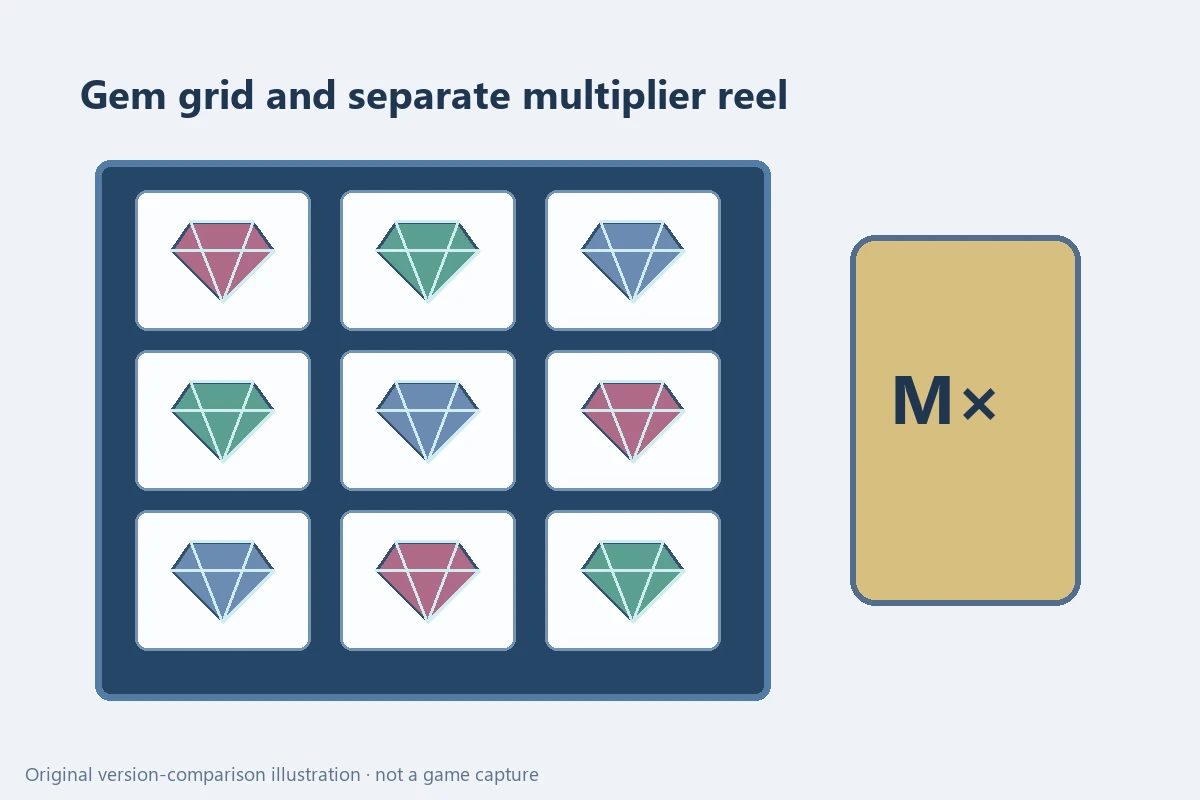
The first original picture shows a small gem grid beside a separate multiplier reel. That separation reflects the first and second product descriptions' references to values on the right. The image uses original gems and symbolic values, so it illustrates the relationship without reproducing an official screen or assigning an undocumented payout to a made-up arrangement.
The multiplier reel and the base line result are different layers
Fortune Gems describes the right-side multiplier in connection with a line result, and the second edition says it retains payline wins together with the multiplier reel on the right. A line combination and the multiplier attached to its result therefore need to be identified separately. The multiplier field is not another ordinary gem required to complete the same line. 12
An invented explanatory example can call the line result L and the applicable multiplier M. The letters keep the two quantities distinct without choosing a monetary amount or asserting a value distribution. Before any arithmetic, the actual rules must establish which multiplier belongs to which result. A bright multiplier-looking object elsewhere on a screen is not enough to complete that relationship.
This distinction also prevents a common comparison mistake: interpreting a higher published maximum as a change to the number of lines. The maximum-win field and the line-count field answer different questions. The second edition's description says existing payline wins are maintained alongside the right-side multiplier reel, which is a more precise statement than saying that everything in the game was increased. 2
Fortune Gems 2 adds a named Lucky Wheel emphasis
The second game's official description links Scatters with the Lucky Wheel and presents that feature as an enhancement within the sequel. The available text does not provide a complete numbered wheel distribution or a probability of reaching it, so neither appears in this article. The name and relationship are documented; the missing numerical details remain outside the comparison. 2
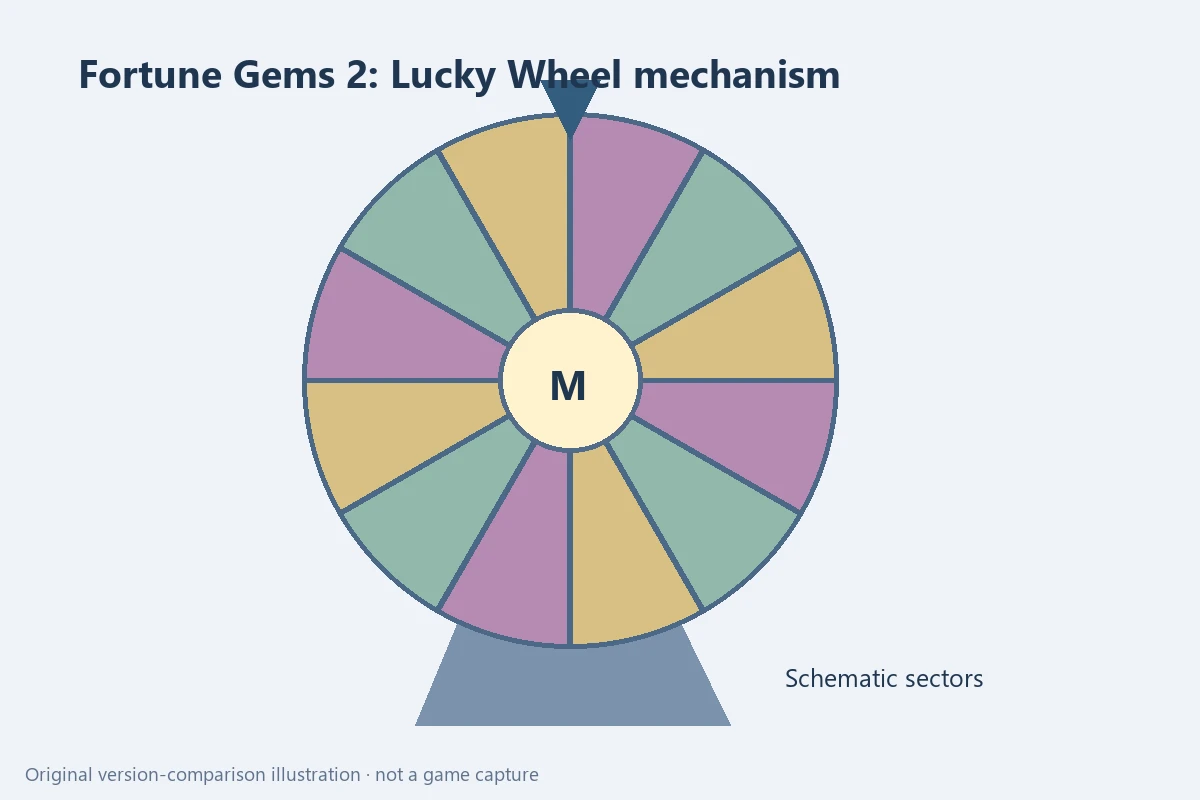
The wheel identifies the sequel’s named mechanism; its schematic sectors are not a probability or payout map. The wheel illustration is consequently a physical-style schematic with symbolic compartments. Its role is to distinguish a circular feature mechanism from the base gem grid and separate multiplier reel. The few visible divisions are not a copied official wheel specification. A reader should not count those illustrated divisions to calculate a trigger chance or assign a reward to an imagined stopping position.
A Scatter-triggered feature also needs to be distinguished from a normal line win. The relevant symbol category matters, not merely whether the screen contains several similar-looking gems. A clear explanation names the Scatter condition when discussing access to the wheel, and names the line combination when discussing an ordinary line result. Without that distinction, a sequel's feature description can be misread as a statement about every base result.
Symbol splitting is the third edition's distinct named mechanism
Fortune Gems 3 explicitly names symbol split and describes a three-by-three board with five connections. Those statements identify the third edition's product presentation, but they do not define every stage of the split or its arithmetic in the retrieved English text. We therefore show a gem dividing as an explanatory object rather than fabricate a before-and-after payout. 3
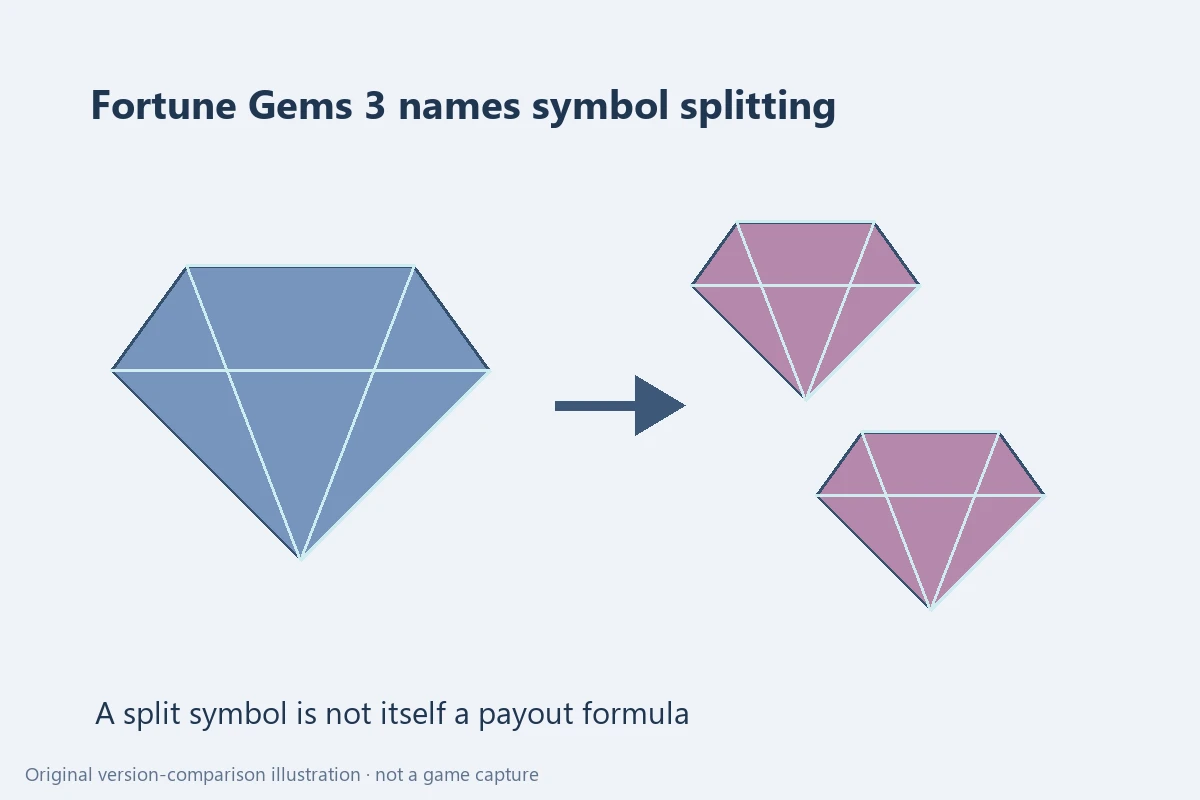
The symbol split becomes concrete without inventing its trigger or a doubled reward. A split concerns what happens to a symbol representation; a multiplier concerns a value relationship. Treating the two as synonyms would erase the very difference the third edition names. For example, observing two fragments where a gem had been does not by itself establish that a reward doubled. The applicable rule would have to connect that state change to the calculation before a numeric conclusion could be drawn.
The board-size statement is similarly limited. Three by three describes visible positions, while five lines or connections describes the supplier's combination field. Nine visible positions do not imply nine lines, and five published lines do not identify their exact paths without the relevant paytable. The article retains both dimensions instead of drawing unsupported line routes across an invented grid.
Keep supplier labels attached to the correct edition
The published maximum-win fields differ: Fortune Gems shows 375 times, Fortune Gems 2 shows 10,000 times, and Fortune Gems 3 shows 10,125 times. Their volatility labels are LOW-MED, MED and HIGH-MED respectively. These are named supplier fields, not session results or independently estimated statistics. 123
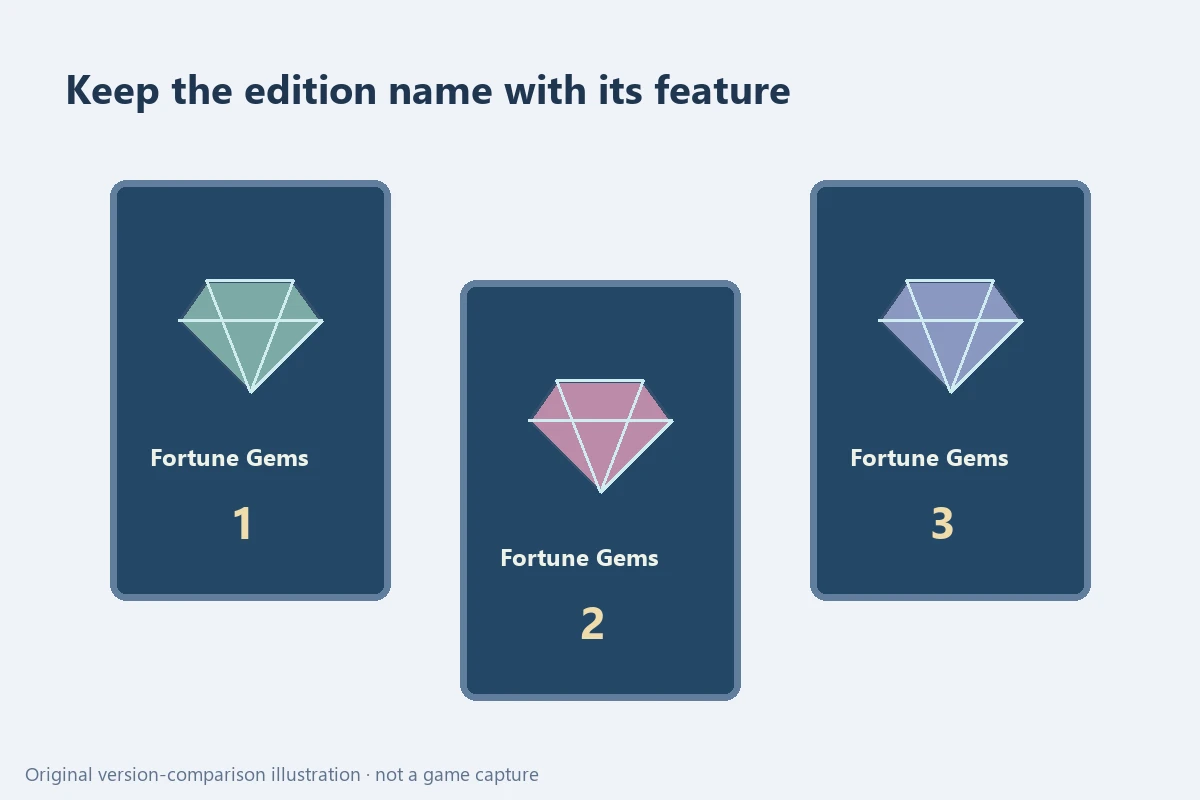
The edition cards keep titles distinct when comparing published maximum and volatility fields; they are not official covers. The categories should not be translated into a claim about a particular reader's likely experience. A maximum does not reveal how often it can occur, and a qualitative volatility label is not a probability percentage. The values are useful here because they prevent a number from one edition being pasted onto another page, not because they identify a preferable choice.
The publication fields also need careful interpretation. The current first and second records both show December 2023, while the third shows April 2024. That shared metadata does not establish that the first two games originated simultaneously. It is safer to preserve the visible fields as record identifiers than to construct an unsupported complete release chronology. 123
The series comparison is a map of documented differences
The strongest differences are the named interactions rather than the series artwork. A separate multiplier reel, a Scatter-related Lucky Wheel and a symbol-splitting description help a reader identify which explanation belongs to which title. Shared gems, the Garuda theme and the five-line field do not cancel those differences. 123
When encountering a cropped image, start with the full title if it is visible, then the object carrying the claimed feature. A circular wheel and a split gem support different descriptions. If the crop hides the title or the condition, the conclusion should stay narrow. This avoids turning a recognisable series theme into a universal rule and preserves the edition-specific information that makes the comparison useful.