Start with the shared pay-anywhere idea
Both product explanations describe matching symbols across the screen rather than requiring an ordinary fixed-line route. The original page identifies eight to thirty matching symbols across six tumbling reels. The 1000 page specifies a six-by-five grid and at least eight matching symbols, including crowns, goblets and gems. 12
The practical consequence is that position and count answer different questions. A symbol can be visible somewhere on the grid without forming part of an eligible matching group. Conversely, the relevant matching symbols need not be drawn along a single horizontal stripe simply because that is a familiar way to picture a slot result. Counting the matching type is the first task; applying the documented count category is a separate one.
For a conceptual example, eight matching gems can be highlighted among other objects in a six-by-five teaching grid. The highlight illustrates the count-based relationship without assigning a payout. It also avoids suggesting that the other symbols vanish merely because they are not part of that match. A paytable is still needed to connect an eligible count and symbol type to a numerical result.
Tumbles change the board within a sequence
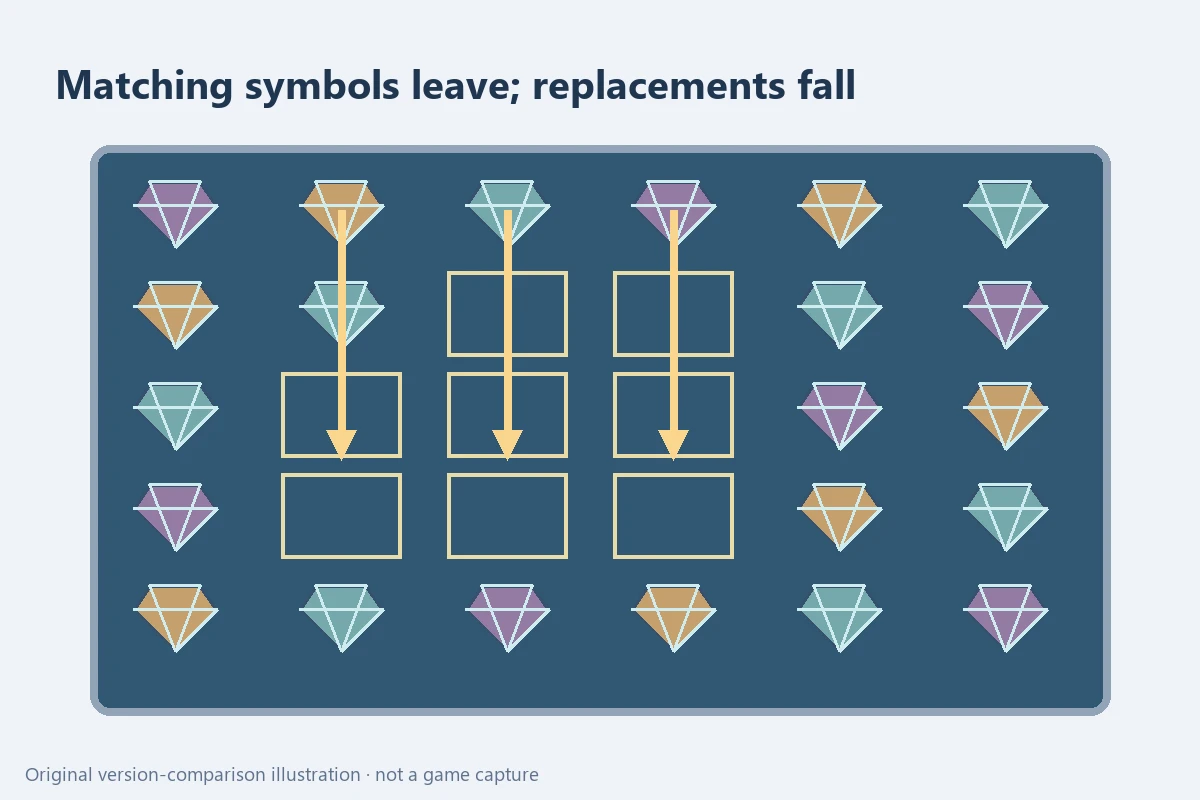
The 1000 page explains that winning combinations are removed and new icons fall into the vacated places. The original title also describes tumbling reels. This distinguishes a continuation within a result sequence from a completely new reader-selected event. The later board can contain replacements while retaining the context of the sequence that produced them. 12
The falling-symbol illustration makes that change concrete. Vacated positions appear below incoming original jewel shapes, with arrows showing the direction of movement. It is a schematic explanation of removal and replacement, not a captured combination or a prediction of the next objects. The arrows describe motion; they do not indicate a route that matching symbols must follow to qualify.
A still frame containing new symbols cannot, by itself, document the entire preceding chain. It may show the board after a removal but omit the combination that caused it. This is why a useful account names the stage: before removal, during replacement or after the next evaluation. Without those distinctions, a tumble can be mistaken for a separate spin or an animated transition with no rule significance.
Multiplier-symbol ranges are an explicit version difference
The original product page gives an upper value of 500 times for multiplier symbols. Gates of Olympus 1000 describes randomly assigned values from two to one thousand times when those symbols land during spins or tumbles. These are symbol-value descriptions for the named versions; they are not the same field as a total possible game win. 12
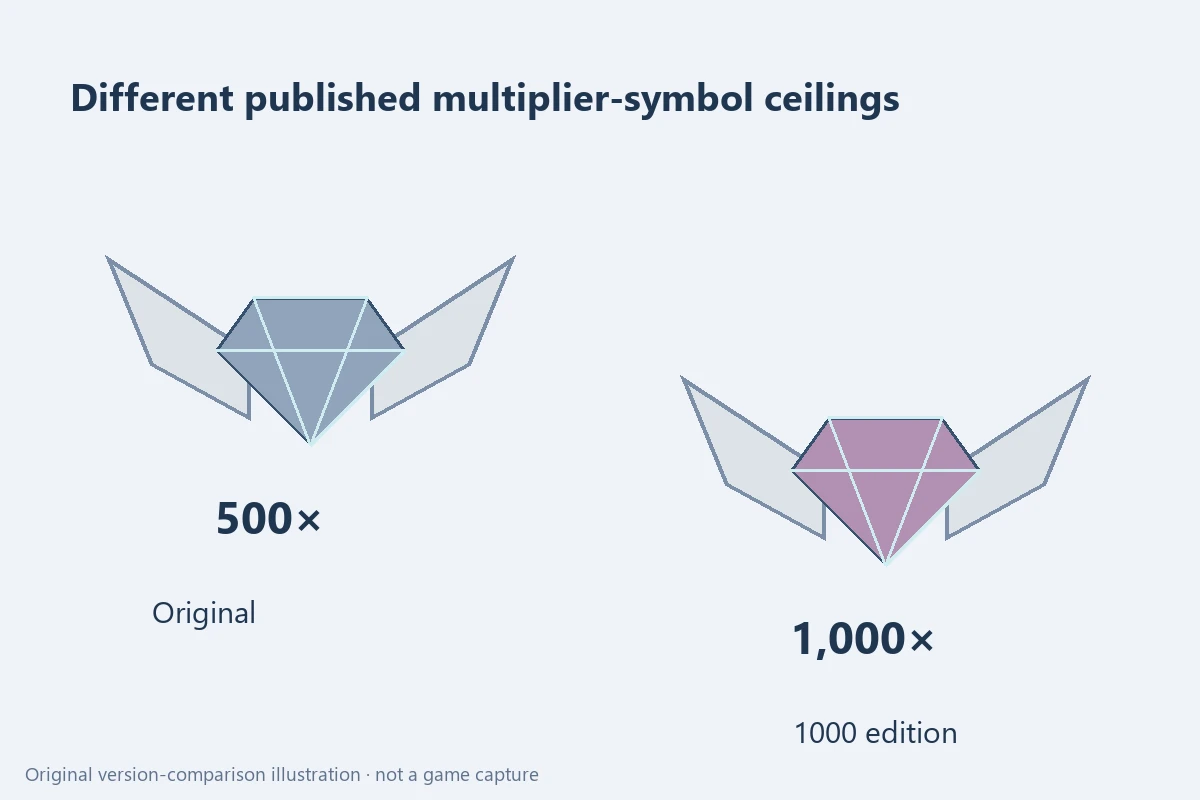
A large multiplier symbol is therefore not evidence that every result receives that value. Its appearance, the applicable winning result and the rule connecting them all matter. The 1000 page says values are combined at the end of a tumble sequence and applied to the win. That sequence-level wording should be retained instead of attaching each displayed number to an unrelated earlier frame. 2
The paired winged-gem illustration places the two published ceilings beside different original objects. It communicates a documented numerical contrast without reproducing the supplier's art. It does not estimate how often either value occurs or rank the games by profitability. The larger upper label describes a different range boundary, not a guarantee about an ordinary outcome.
Four Scatters and fifteen starting free spins are shared fields
Both named pages connect four or more Scatters with an initial free-spin feature of fifteen games. The common trigger and starting count are important precisely because they are not the contrast implied by the 1000 suffix. A new edition name does not mean that every field changes. 12
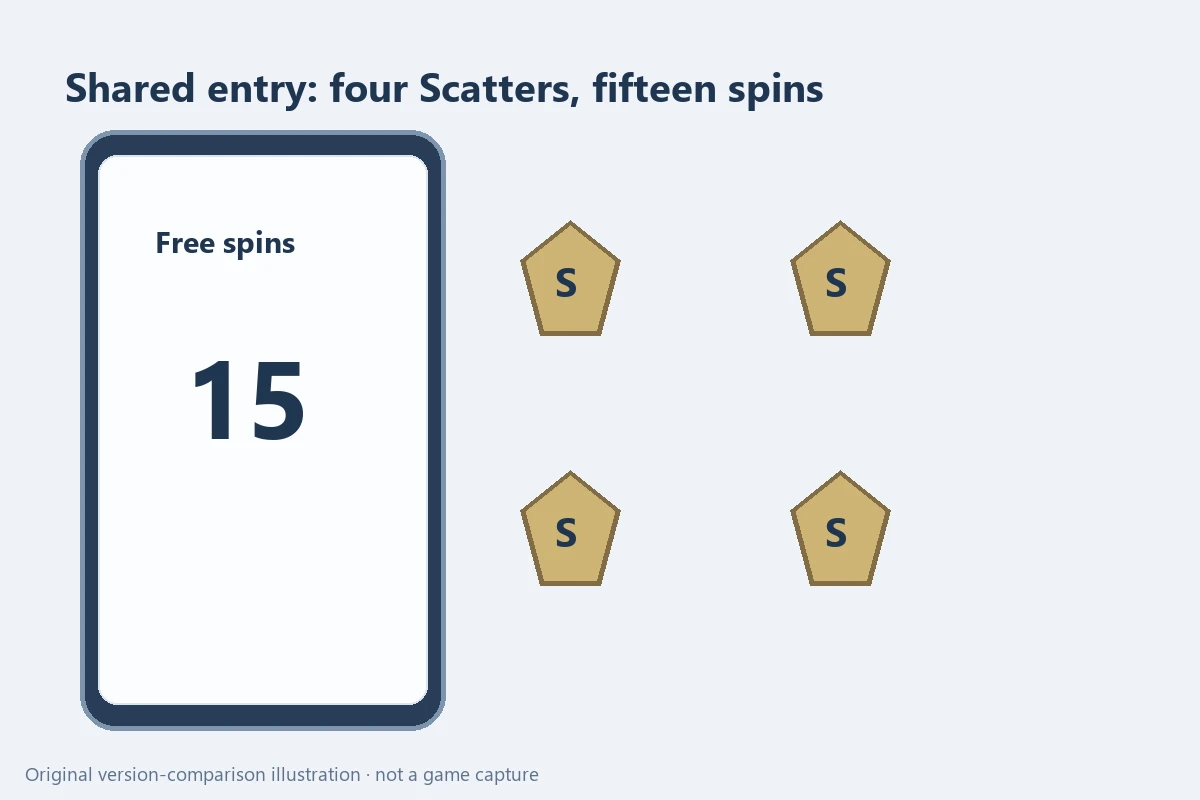
The Scatter count and the awarded game count should be kept separate. Four qualifying symbols identify the stated entry condition; fifteen describes the initial feature allowance. Multiplying the two figures would invent a rule. Similarly, seeing a counter display does not establish the exact symbol arrangement that opened the feature unless that earlier state is also available.
Our original counter screen groups four illustrative Scatter emblems with a fifteen-game field. The emblems are generic and not copied Zeus artwork. The diagram explains the published relationship while avoiding an apparent official screenshot. It contains no action button, account value or invitation to trigger the feature.
Feature accumulation needs its own reading context
The original page says winning multiplier symbols in the feature are added to a running total that applies to the respective win. The 1000 description similarly refers to adding new multiplier values to the bonus round's total. A running total and an individual symbol value should therefore not be confused. 12
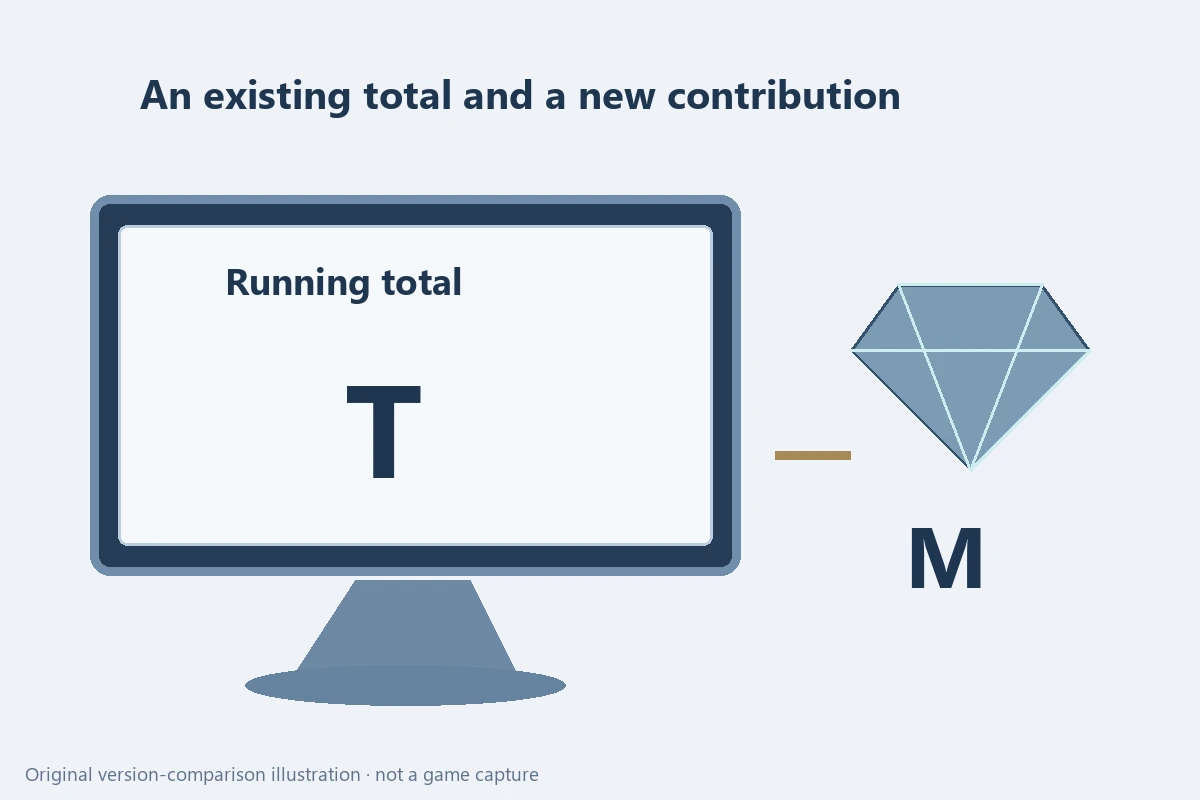
Imagine a symbolic total T displayed separately from a newly arrived multiplier M. Those letters stand for different states: the amount already accumulated and a new contribution subject to the feature's condition. The example deliberately supplies no numeric sequence. Its purpose is to explain why the displayed total can carry context that is absent from a cropped image of one symbol.
The 1000 product page also states that three or more Scatters during the bonus award five additional free games. That is explicit retrigger wording for the compared 1000 source. The original short product text used here does not state an equivalent retrigger count, so the comparison does not fill that row by copying the later edition's number. 2
A bounded comparison is more useful than a universal series rule
These two releases share a recognisable visual theme, a tumble-based presentation and several feature fields, while the official descriptions document specific numeric and wording differences. The series name alone cannot determine which multiplier range or retrigger statement belongs to a screen. The complete title remains part of the rule context.
This article omits an RTP comparison and a ranked recommendation. The public snapshots are not a substitute for the exact configuration served by an operator, and the larger multiplier ceiling does not settle the distribution or expected result of a session. The useful conclusion is narrower: preserve the full release name, distinguish symbol values from running totals, and attach each condition to the official page that actually states it.